
AI vs deepfake: where one ends and the other begins
Short version: AI is the broad field, and a deepfake is one narrow thing AI can do. A deepfake imitates a real, identifiable person to make them appear to say or do something they never did, usually to mislead. So every deepfake is AI-generated, but most AI-generated media, text-to-image art, synthetic faces of people who do not exist, is not a deepfake. The dividing line is identity. If no real person is being impersonated, you are looking at AI media, not a deepfake.
AI vs deepfake: the one-sentence answer
Artificial intelligence is the umbrella. A deepfake is a single application sheltering under it. Quillbot puts the rule cleanly: all deepfakes are AI-generated, but not all AI-generated images are deepfakes. Many AI images come from text prompts and never pretend to be a real person or a real event.
What pulls a piece of media into the deepfake column is intent plus a target. The content is engineered to imitate a specific real person, and it is usually meant to deceive. Strip the real, identifiable person out of the equation and the deepfake label falls away.
What 'AI' actually covers
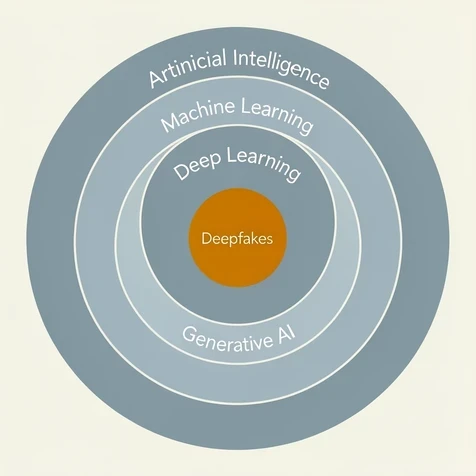
AI is a stack of nested fields, each sitting inside the last. Picturing that nesting is the fastest way to see where deepfakes live and why they are such a small corner of the whole.
- Artificial intelligence is the outermost layer: any system that performs tasks we associate with human intelligence.
- Machine learning sits inside it, learning patterns from data rather than following hand-written rules.
- Deep learning is a kind of machine learning that uses neural networks with many hidden layers. The more hidden layers, the deeper the network.
- Generative AI, powered by deep learning, produces new images, text, video, and audio.
- Deepfakes are one specific output of generative AI, and only one.
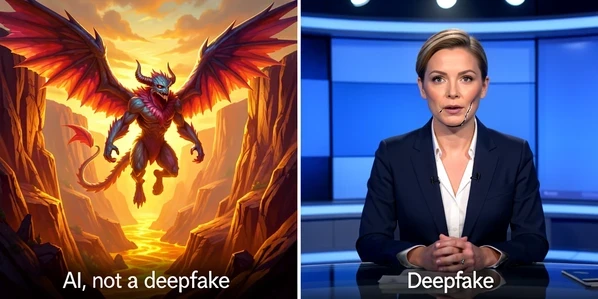
Notice what fills most of that stack. A text-to-image tool that paints a dragon over a burning city is generative AI doing its job, and it impersonates nobody. A synthetic portrait of a smiling office worker who has never existed is also AI media, not a deepfake. Those outputs share the same deep learning plumbing as a deepfake. They just never point at a real human being.
What makes something a deepfake specifically
The name gives it away. Deepfake is a portmanteau of 'deep learning' and 'fake', and the 'deep' is literal: it points at the deep learning underneath. That is why a quick Photoshop edit or a non-deep-learning filter does not qualify, even though both produce a fake.
The defining trait is impersonation. As the Brookings Institution describes it, a deepfake is constructed to make a person appear to say or do something they never said or did. Proofpoint frames the mechanism well: a deepfake works like a prediction engine that learns how a target looks, sounds, and moves, then generates fresh content with enough fidelity to fool an observer.
It is a form of synthetic media built from learned patterns of a target's face, voice, and movement. Delivery usually happens through a face swap or a rebuilt likeness. And it is not only video. Deepfakes span images, video, and audio, so a cloned voice on a phone call is just as much a deepfake as a swapped face on screen. Treating the word as video-only quietly undercounts the category.
The decision tree: is this a deepfake or just AI?
Run any clip, photo, or voice memo through three questions in order. If you reach the end with three yes answers, you are almost certainly looking at a deepfake.
- Is it AI-generated or AI-edited at all? A no here means it is an ordinary recording, not synthetic media of any kind.
- Does it depict a real, identifiable person, rather than someone who does not exist? A synthetic stranger fails this step and stays in the plain AI bucket.
- Is it engineered to pass as that real person, instead of being openly creative or obviously fake?
Now watch the borderline cases sort themselves. An AI-generated fantasy artwork answers no at question two: no real person, so it is AI media, not a deepfake. A photoreal portrait of a non-existent influencer also stops at question two. A face-swapped video of a sitting senator clears all three and lands squarely as a deepfake.
Disclosure is the interesting twist at question three. A parody or a technology demo might use the exact same deepfake methods, yet announce itself as fake. Technique still makes it a deepfake by construction, but the open label changes how it is judged. Fortinet notes that disclosed uses, parody, technology demonstrations, historical recreations, are generally treated as acceptable. A cloned-voice call from a 'relative' built off three seconds of audio sits at the opposite pole: identity targeted, deception intended, fully an audio deepfake.
Why the distinction matters
Because the harms people pin on 'AI' come almost entirely from the deepfake subset, not from AI media at large. The numbers track the danger, and they are climbing fast. Proofpoint reports that deepfake files found online grew from roughly 500,000 in 2023 to an estimated 8 million in 2025.
The money follows. According to Proofpoint, U.S. deepfake fraud losses topped $1.1 billion in 2025, more than triple the $360 million lost the year before. The entry cost for an attacker, meanwhile, keeps dropping. The same source notes that deepfake voice cloning can work from as little as three seconds of audio. Three seconds. That is a voicemail greeting.
The liar's dividend cuts both ways: as convincing fakes spread, a person caught on genuine footage can wave it away as 'just a deepfake'. The distinction protects real evidence, not only its targets.
Detection skill is uneven, which is why a mental model beats eyeballing. A University of Florida study found AI programs were up to 97% accurate at flagging deepfake still images, while humans correctly sorted real and fake videos only about two-thirds of the time. People are not reliable detectors, especially on video, so a repeatable test matters more than a gut feeling.
Common mix-ups to drop
A few stubborn assumptions keep the two terms tangled. Clearing them out makes the whole distinction click.
- Not every AI image is a deepfake. A prompt-made picture that depicts no real person never qualifies.
- Deepfakes are not a Snapchat or Photoshop face-swap with better polish. Those are obviously fake on sight, whereas deep learning can make a deepfake realistic enough that people cannot tell.
- Building a convincing one no longer takes elite skill. Deepfake-as-a-service platforms and real-time synthesis let attackers with little programming knowledge clone voices and run live video calls.
Hold onto the one rule that organizes all of it: every deepfake is AI, but most AI is not a deepfake. Once identity is your test, the word 'deepfake' stops being a synonym for 'AI' and goes back to meaning the one narrow, person-targeting thing it was coined to name.