
Sued for a Deepfake: Matching Your Situation to a Claim That Can Win
Can you actually sue someone for a deepfake? The short answer
Yes, often you can. But not because the deepfake exists. Making an AI video is not inherently unlawful, as jnylaw.com puts it plainly: a claim arises only when someone uses your likeness without consent in a way that harms you. The harm is the hook, not the technology.
So drop the binary. A deepfake is neither automatically illegal nor automatically protected. Whether you have a case turns on three things: what kind of harm you suffered, where you and the creator are, and what you can actually prove. Those variables decide everything that follows, including whether suing is even worth your time.
Match your situation to the right claim: a decision map
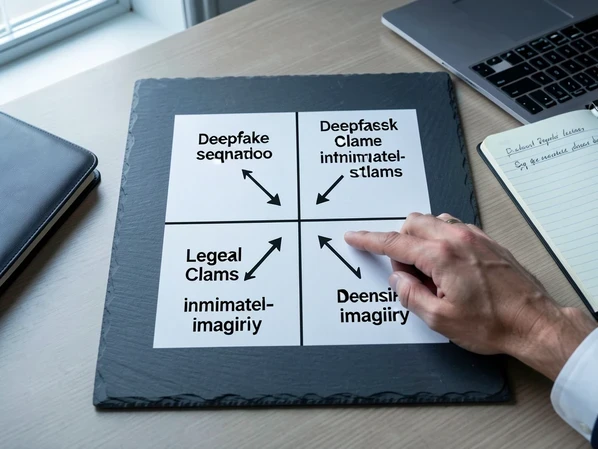
Most articles hand you an undifferentiated list of possible claims and leave you to guess. That is useless when you are scared and need to act. Sort your situation into one of four buckets first, then read across to the claim that fits.
| Your situation | The claims that fit | What you must show |
|---|---|---|
| Nonconsensual intimate imagery | State NCII and deepfake statutes, the DEFIANCE Act federal civil right, invasion of privacy, intentional infliction of emotional distress | That the explicit content depicts you and was shared without consent. Newer laws drop the need to prove the image is real or who made it. |
| Defamatory or false portrayal | Defamation, plus false light in states that recognize it | A false factual implication that a reasonable viewer would take as real, and resulting harm. |
| Commercial use of your likeness | Right of publicity / misappropriation, Lanham Act false endorsement | That your identity was used to sell or endorse something. Commercial use is the gate, and it is a high one. |
| Fraud using your face or voice | Fraud, identity theft, and related financial-deception claims | That the deepfake deceived someone and caused a measurable loss. |
Two distinctions trip people up. False light is not the same as defamation. Defamation polices reputational damage from a false statement of fact; false light targets a misleading portrayal and the emotional distress it causes, even when nothing strictly defamatory was said. A deepfake that paints you in a creepy or humiliating context can be false light without clearing the defamation bar.
The second trap is right of publicity. It feels like the obvious tool, but honigman.com notes it typically requires showing commercial use of your identity. If an anonymous troll made a humiliating clip for harassment rather than profit, there is no commercial use to point at, and the publicity claim collapses. That gap is exactly why the newer intimate-imagery statutes matter so much.
Two real cases bracket the commercial and fraud ends of the map. In April 2023 Kyland Young brought a right of publicity claim against NeoCortext, the developer behind the deepfake app Reface, alleging it violated California's publicity law, the kind of suit that only works because a product was monetizing his likeness. At the other end sits financial deception: a Hong Kong engineering firm lost $25 million in January 2024 when an employee joined a video call populated by deepfaked versions of the company's CFO and colleagues, a harm that is fraud, not likeness misuse.
The laws on your side: federal and key state statutes
The legal ground shifted fast in 2025 and 2026, and the new statutes are written specifically for victims like you. Knowing their names lets you cite them when you report and when you talk to a lawyer.
Start federal. The TAKE IT DOWN Act, signed into law in May 2025 per thelyonfirm.com, criminalizes knowing publication of nonconsensual intimate deepfakes and forces covered platforms to pull reported content within 48 hours of notice. The DEFIANCE Act goes further on the civil side. The U.S. Senate passed it unanimously in January 2026, and it sits before the House now. It would give victims a federal civil right to sue creators and distributors of nonconsensual explicit deepfakes for statutory damages of $150,000 to $250,000, with no need to prove commercial motive or public-figure status. The NO FAKES Act, described by jnylaw.com, would add liability and statutory damages against anyone who creates or shares an unauthorized digital replica without consent.
States moved earlier and often hit harder in practice. Texas is the clearest worked example. Penal Code 21.165 criminalizes creating or distributing a deepfake depicting a person with intimate parts exposed or in sexual conduct without consent, and Civil Practice and Remedies Code Chapter 98B lets a victim sue anyone who discloses or promotes artificial intimate visual material for actual damages, exemplary damages, injunctive relief, and attorney's fees, per edgettlawfirm.com. That fee-shifting matters: it can make a lawyer take a case that small actual damages alone would not justify.
- California passed AB 602 and AB 730; AB 602 lets you sue for damages when a deepfake puts you in pornography without consent.
- Illinois' Biometric Information Privacy Act, 740 ILCS 14/1, lets individuals sue any company that uses their biometric data without consent, and the Facebook photo-tagging case settled for $650 million.
- Washington offers possible remedies under RCW 63.60, RCW 9A.60.045, and RCW 9A.86.010 depending on the facts.
- Beyond the deepfake-specific statutes, AI litigation also draws on the Copyright Act, the Lanham Act's false endorsement provisions, and state right-of-publicity law, per daeryunlaw.com.
One number frames why all this legislation arrived at once. jnylaw.com cites estimates that deepfake videos rose by roughly 550% between 2019 and 2024, with tens of thousands now circulating. Lawmakers are chasing a curve, which is also why coverage is uneven from state to state.
First 48 hours: preserve evidence and report before you sue
Before any lawsuit, there is triage. Evidence disappears fast, as jnylaw.com warns, and a clip that vanishes before you capture it is a claim you cannot prove. Do these things in order, today.
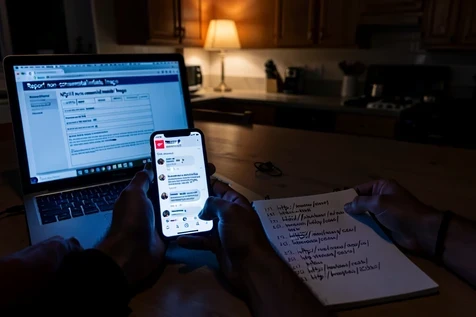
- Download the content itself and screenshot every URL where it appears, with the date and time visible.
- Note where it was posted, who shared it, and any usernames or account handles, even if they are obviously fake.
- Report it through the platform's NCII-specific form, not the generic report button, and state explicitly that the content is AI-generated so it triggers the 48-hour removal duty.
- Register a hash of the image at stopncii.org so participating platforms can block re-uploads automatically.
- File a Google de-indexing request to pull the content out of search results.
- File a police report, and for cross-state or online fraud add a complaint at ic3.gov.
A short walkthrough for the most common case. An intimate deepfake surfaces on a social platform: you report through its NCII form citing the TAKE IT DOWN Act's 48-hour rule, register the hash at stopncii.org so it stops resurfacing, file the de-indexing request, then lodge a police report. Notice that none of this requires a lawsuit yet. It also does not require you to prove the image is real or to name the creator, which is the whole point of the newer reporting regime.
The practical walls: anonymous creators, overseas defendants, and platforms
Here is what the cheerful guides skip. A valid claim and a collectible judgment are two different animals. nationalsecuritylawfirm.com lists the recurring obstacles: perpetrator anonymity, cross-border jurisdiction, the difficulty of proving damages, and an evolving legal landscape with no uniform standard. Each one can stop a technically sound case cold.
Anonymity comes first because you cannot sue a username. Unmasking the creator may require a subpoena to the platform, and even then the trail can dead-end at a VPN. If the person is overseas, you face the further problem of whether a U.S. court has jurisdiction and whether any judgment can be enforced abroad. Win in court against a creator in a country that ignores the ruling, and you hold a worthless piece of paper. The same goes for a judgment-proof defendant at home: a teenager with no assets cannot pay $200,000 no matter what the statute promises.
Which pushes people toward suing the platform, where the money is. That door is mostly shut. In the US, Section 230 immunity is the standard shield for hosting user content, and whether it covers AI-generated material is still contested rather than settled. In the UK, intermediaries are generally protected too; the Online Safety Act pressures platforms to remove content but gives victims no private right to sue them for compensation, per carruthers-law.co.uk. Takedown leverage, yes. A damages defendant, rarely.
What the creator might argue back: the First Amendment defense
Expect the creator to reach for free speech. honigman.com notes a deepfake maker may raise a First Amendment defense by framing the work as transformative protected speech: parody, satire, or commentary. You have heard the casual version of this argument already. "It's a deep fake, relax." "It's not really you, it's art." In court that posture has teeth.
It bites hardest on defamation. If a clip is plausibly satire, you struggle to show the audience took it as a statement of fact, and without that the defamation claim wobbles. This is why non-intimate, commentary-style deepfakes are genuinely harder to sue over than intimate ones. The intimate-imagery statutes sidestep the debate by not requiring you to prove a false factual assertion at all. A nude that was never consented to is not redeemed by calling it parody.
If you are in the UK: a different legal route
UK readers cannot borrow the American playbook, because English law recognizes no general image or personality right. carruthers-law.co.uk explains that victims instead assemble a claim from defamation, misuse of private information, data protection, passing off, and malicious falsehood, picking whichever fits the facts.
The criminal side moved first. Under the Online Safety Act 2023, sharing nonconsensual intimate images including deepfakes became a criminal offence from January 2024, and the forthcoming Crime and Policing Bill 2025 is set to criminalize creating sexually explicit deepfakes. Data protection law does real work for civil remedies: UK GDPR Article 17 gives a right to erasure, letting you demand platforms delete unlawfully processed personal data, and section 168 of the Data Protection Act 2018 allows compensation that explicitly covers emotional distress, not just financial loss.
And the anonymity problem has a named tool here. A Norwich Pharmacal order can compel a platform or intermediary to hand over information that identifies an anonymous perpetrator, turning a faceless account into a defendant you can actually serve.
Civil suit vs. criminal report: which path fits your goal
People conflate two very different actions. A civil lawsuit is you suing for money damages or an injunction. A criminal report hands the matter to police and prosecutors, who may charge the perpetrator, but any penalty goes to the state, not your bank account. They can run in parallel, yet they serve different ends.
Let your goal pick the path. If what you want is the content gone, the fastest levers are NCII reporting, hashing at stopncii.org, and de-indexing, all of which move quicker than litigation. If you want compensation, the civil route is the one. If you want the person punished, that is the criminal report. Texas shows the criminal stakes concretely: a Penal Code 21.165 violation is generally a Class A Misdemeanor carrying up to a year in jail and a $4,000 fine, and it can rise to a third-degree felony punishable by 2 to 10 years depending on the facts, per edgettlawfirm.com.
One more flip side worth knowing: deepfakes also surface inside litigation as fabricated evidence, where a court must decide whether a submitted clip is genuine at all. That is the mirror image of your problem, and it is why courts are growing more alert to manipulated media, which can help when authenticity becomes the fight.